
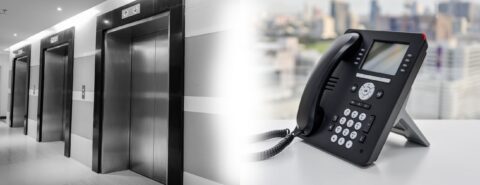
The UK’s copper phone network is being retired. By 31 January 2027, the Public Switched Telephone Network (PSTN) and ISDN will be switched off. The industry has already stopped selling new analogue services, so any move, change or regrade pushes you to digital by default. If you run a large, multi-tenant office, shopping centre, retail park or science park, this affects more than the phones. It also affects the lifts, alarms, access control systems, CCTV and plant machinery. According to Openreach [February 2026], there are still half a million PSTN lines serving business premises. And if you’re one of them, the costs rise, and the likelihood of disruption grows.
What is being withdrawn
We are moving from old analogue copper lines to an all-IP environment. Voice services will now operate over broadband connections. Access will utilise full fibre where available, or copper-based data services such as SOGEA, in areas where fibre has not yet reached your building. Openreach has already implemented a national stop-sell on Wholesale Line Rental, meaning that new PSTN or ISDN services are no longer available. As mentioned earlier, the final shutdown date for the legacy network is scheduled for January 31, 2027.
The rising cost of doing nothing
Openreach is increasing wholesale charges on legacy copper lines through 2026. The rises are staged across the year, starting at plus twenty per cent, then a further forty per cent, then a final forty per cent that roughly doubles costs by October. This is meant to accelerate migration and to reflect the higher cost of keeping an ageing network alive.
There is also a service risk. The old network is more fragile, and faults are harder to fix at scale. BT highlights rising incident volumes on the analogue network and is urging firms to move to digital lines. Leaving it late increases the chance of outages during busy migration periods.
If you still have lines on PSTN at switch off, remaining services may fall back to Emergency Voice Access. EVAC only supports emergency voice calls. It does not support broadband or machine signalling, so things like payment terminals and alarm systems would stop working until you migrate them.
Where buildings break
In our world of office complexes and mixed-use commercial estates, dependencies on analogue technology often go unnoticed. Common examples include emergency phones in lift systems, fire and intruder alarm signals sent to an Alarm Receiving Centre (ARC), door entry systems and intercoms, car park barriers, Automatic Number Plate Recognition (ANPR), and remote access to CCTV. Building Management Systems (BMS), meters, pumps, tank level sensors, and leak alarms frequently rely on dial-out modems or use voice lines as backup communication channels. In some retail environments, payment devices may still operate using dial-up connections. Any of these systems can fail if a telephone line is converted to digital voice without a proper upgrade.
The old network could power a basic handset from the exchange. Digital lines run through routers and ONTs that need power in the building. Ofcom expects providers to ensure at least one hour of access to the emergency services for dependent users during power cuts. In commercial buildings, managing agents should plan local backup power for routers, switches and ONTs that support life safety and critical services.
Life safety and compliance
For alarm signalling, building operators should follow the current standards and their insurer’s guidance. BS EN 50136-1 defines performance for alarm transmission systems. In higher-risk premises, dual path signalling with IP plus cellular is common. Do not assume an analogue dialler will work if you plug it into a VoIP adaptor. Specify the right signalling grade, agree it with your ARC and insurer, and test end-to-end.
Lift alarms require special attention. The updated standard, EN 81-28:2022, mandates that the automatic three-day test must mimic a real alarm call. It also specifies that both the auto dialler and the GSM or IP transmitter must have a monitored battery backup when integrated.
In practice, ensure you install the correct dialler, verify the live connection to the receiving centre, and conduct tests during a power outage before accepting the upgrade.
Access, listed buildings and wayleaves
Full fibre brings long-term benefits, but path and permissions can take time. The government’s guidance on access agreements explains the framework under the Electronic Communications Code. Openreach also sets out when it needs a wayleave and how to engage. In listed or heritage assets, agree routes early and factor in methods that protect the fabric of the building. This avoids last-minute compromises on service quality and timescales. And remember, you must obtain Listed Building Consent from your local planning authority for any modifications that could affect the building’s historic character, including internal or external cabling.
What does the PSTN switch off means for managing agents and building managers?
There are three main areas to focus on. First, ensure that lifts and fire systems remain operational. You need to replace analogue diallers, set the appropriate signalling grade, and add power resilience where necessary. Confirm everything with your ARC and the lift company, and make sure to record your test results.
Next, eliminate any hidden single points of failure. Ensure that door entry systems, gates, barriers, and CCTV maintain their call paths and remote access after transitioning to digital. Check the Building Management System, metering, and environmental alarms for any legacy modems and replace them with IP or cellular modules. Also, have a local power backup for the network equipment that connects everything.
Lastly, let’s discuss governance. It’s important to plan stakeholder communications and incorporate approval processes into the timeline. The second edition of the RICS standard on Service Charges in Commercial Property emphasises the need for transparency and effective procurement. Providing clear briefs, establishing tested outcomes, and maintaining proper records can help minimise disputes and facilitate smoother service charge recovery. If an RICS-regulated firm fails to proactively manage the PSTN switch-off, which could result in critical system failures, this may be regarded as professional negligence.
The bottom line
The copper switch-off is a national change with a fixed end date. Prices on legacy lines will climb throughout 2026, and services that depend on a dial tone will fail without a planned upgrade. The fix is straightforward if you start now, prioritise safety, address power, and test what matters. After all, your tenants expect your building to work, and under the RICS 2025 Standard, ‘waiting for failure’ is not a strategy; it’s a breach of professional conduct.
Contact Modern Networks
If you want help to audit sites, plan migrations, upgrade lift and alarm signalling, and move to cloud telephony, get in touch and we will get you moving.